
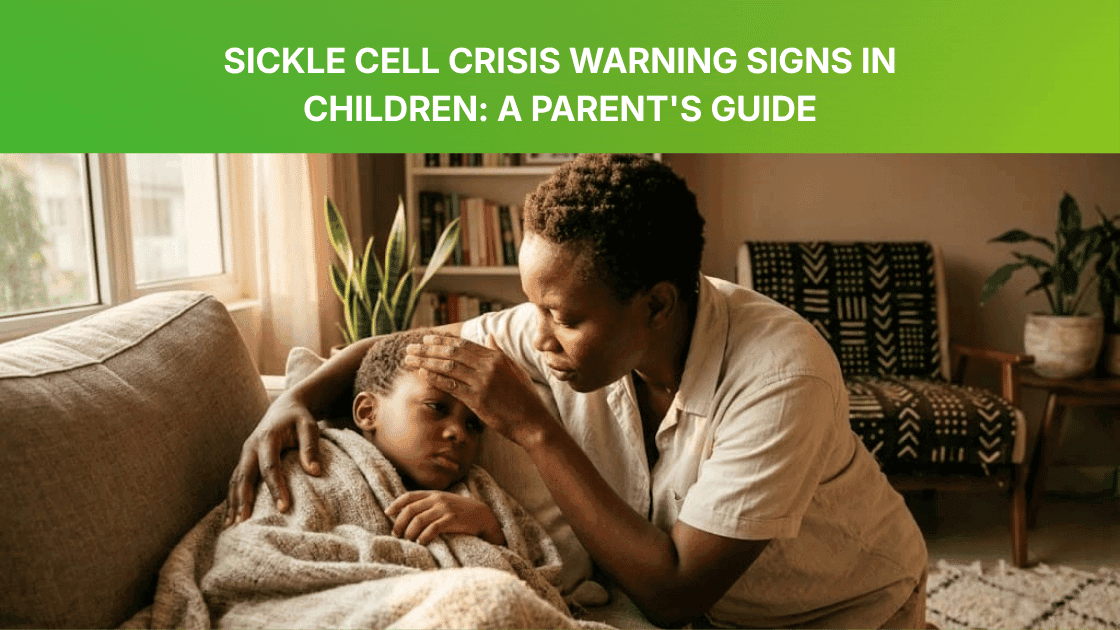
Most parents of children with sickle cell disease can describe a full crisis when they see one: the crying, the refusal to move, and the sharp pain, but by that point, the window for early intervention has already closed.
Research published in the journal Pain in 2024 found that caregiver and child pain assessments in sickle cell disease agree only moderately at best, meaning parents are regularly working with incomplete information during a crisis.
The early warning signs, the ones that appear hours before the peak, are subtler and easier to miss, although they show up in a child's behaviour, breathing pattern, appetite, and movement, not in a dramatic pain expression. Learning to read those early signals is one of the most valuable skills a parent or caregiver can develop.
Key Takeaways
- Caregiver and child pain reports in SCD agree only moderately at best (Pain, PMC 2024)
- Early warning signs appear hours before a crisis reaches its most intense stage
- Behavioural changes are more reliable early signals than verbal pain reports in young children
- An individualised crisis plan reduces unnecessary hospitalisations
- Consistent daily symptom logging helps parents spot patterns much faster
Why Does Early Recognition Change Everything?
Catching a sickle cell crisis before it reaches its most intense stage gives families real options. Oral fluids, warmth, positional comfort, and appropriate pain relief administered in the first one to two hours can interrupt a mild episode before it escalates to something that requires hospital care.
A 2022 caregiver study conducted at Tamale Teaching Hospital in Ghana found that while most caregivers recognised the obvious signs of a crisis, very few had been taught to identify the subtle signals that precede it.
The gap between what parents observe and what children are actually experiencing is well documented. Children with sickle cell disease develop coping strategies over time. They learn to suppress visible pain expression.
They manage their discomfort quietly, especially older children and teenagers who do not want to worry their parents or miss school. This means a child who appears calm can still be in the early stages of a significant episode.
Concordance between caregiver and child pain assessments in sickle cell disease is moderate at best. Younger patient age and higher emergency department visit frequency predict the greatest discordance between parent and child reports. This makes behavioural observation a more reliable early detection approach than pain scale reporting alone.

Why Do Children With Sickle Cell Communicate Pain Differently?
How Pain Expression Changes With Age
Young children, particularly under five, often do not have the language to describe where their pain is or how severe it feels. They express pain through behaviour: crying, refusing to use a limb, pulling away from touch, or becoming very still.
Parents who know their child's normal baseline behaviour are best placed to detect a change. A child who is unusually quiet, who stops reaching for their favourite toy, or who refuses to walk when they normally run is communicating something important.
Older children and teenagers face the opposite challenge. They often underreport pain on purpose. They have learned that reporting pain leads to hospital visits, which means missed school, lost social time, and the kind of concern that can feel embarrassing among peers.
A teenager who says "I'm fine" may have developed a pain threshold their parents do not fully understand. Neither the young child's behaviour nor the teenager's silence should be taken at face value without a closer look.
Why Parent and Child Reports Often Do Not Match
Research consistently shows that when children with sickle cell disease and their parents independently rate pain, the scores diverge more often than they align. Parents tend to underestimate pain when children appear outwardly calm and overestimate it when children are visibly distressed.
Neither is a failure of parenting; it is simply what happens when pain has to be read through behaviour rather than direct experience.
This is why having a baseline matters enormously. When a parent knows exactly how their child behaves on a normal day, any deviation from that baseline becomes a meaningful signal, regardless of whether the child is verbally reporting pain.
That baseline knowledge is built over time through daily observation and not through crisis moments.
What Are the Early Warning Signs to Watch For?
Changes in Behaviour and Mood
The earliest signals of a building crisis are often emotional and behavioural rather than physical. A child who becomes unusually irritable, withdrawn, clingy, or quiet is worth paying attention to.
These changes often happen several hours before the pain reaches its peak. In very young children, inconsolable crying without an obvious cause can indicate that something is building in the body.
Watch for reduced play activity and reluctance to engage with things that normally interest the child. A child who sits still when they are normally active, or who does not want to be picked up when they usually enjoy it, may be protecting a part of their body that is beginning to hurt.
Breathing and Movement Patterns
Changes in how a child breathes or moves are among the most reliable early physical signals. Faster breathing than usual, even without obvious distress, can indicate that the body is working harder than normal.
Reluctance to move a specific limb, a slight limp, protective posturing such as holding an arm against the body, or curling up to protect the abdomen are all physical signals worth noting.
In children who develop chest-area involvement, shallow breathing is a key early warning sign. A child taking small, careful breaths rather than their normal deep ones may be unconsciously avoiding the pain of a full inhale.
Shallow breathing during a sickle cell crisis increases the risk of a lung complication developing, so it is both a symptom to watch for and a pattern to gently address.
Appetite, Thirst, and Energy
A sudden drop in appetite, increased thirst, or unusual fatigue can all indicate that a crisis is building. Pain crises are physically demanding for the body, and children often lose interest in food in the hours before or during an episode.
At the same time, their need for fluids actually increases, because dehydration is both a common crisis trigger and a consequence of the increased metabolic demand.
If your child is drinking more water than usual or asking for fluids repeatedly, take that seriously. Thirst is a late signal that the body is already behind on hydration. Acting on it early matters.

When to Manage at Home Versus When to Go to Emergency Care?
Mild to moderate pain that improves with oral fluids, warmth, and appropriate pain relief within one to two hours can usually be managed carefully at home while you continue monitoring.
The general principle is if the situation is improving, continue watching closely. If it is staying the same or getting worse after two hours of home management, seek medical care without further delay.
Certain signs require immediate emergency care without waiting.
These include any chest pain or difficulty breathing, a fever above 38.5 degrees Celsius, pain that is not responding to home management after two hours, sudden swelling of the hands or feet in young children, severe abdominal pain, and any change in your child's consciousness or unusual behaviour. When in doubt, go.
Structured and individualised pain management plans significantly improve outcomes in paediatric sickle cell crises and reduce unnecessary hospitalisation when families are equipped with clear guidance. Inpatient management is most effective when it combines careful pain assessment with both pharmacological and non-pharmacological strategies, and care teams are increasingly emphasising the value of pre-built home management protocols for families.
How to Build a Crisis Response Plan for Your Child
An individualised crisis plan takes the guesswork out of difficult moments. It should cover your child's normal health baseline, the specific early signals you have observed in your child, the first home management steps to take, a clear threshold for when to call the doctor versus go to the emergency room, and your child's haematologist contact details. Keep it written, not just mentally noted.
The plan should be developed with your child's medical team and updated regularly as your child grows and their pain patterns change.
Having it accessible on your phone and physically in your home means you can act quickly and confidently in the early moments of a crisis rather than trying to make complex decisions under stress.

Why Consistent Symptom Tracking Gives Parents an Advantage
Patterns reveal themselves over time. A parent who has been logging their child's symptoms, moods, appetite, and sleep for several months will notice things that are impossible to see in any single episode: that crises tend to follow a run of poor sleep, or that they cluster around particular weather conditions, or that the child always drinks less on the days before an episode begins.
That kind of pattern knowledge is built slowly, but it changes how quickly and accurately you respond. The Eloheh app is designed specifically for this kind of daily tracking in sickle cell disease.
It allows you to log symptoms, record medications, set reminders, and build a documented picture of your child's health over time. That record becomes invaluable in conversations with your child's care team and gives you the data to act faster on early warning signs.
For natural management approaches that support your child's daily health between episodes, visit healingblendsglobal.com. The blog there contains research-grounded guidance on nutrition and supplementation for sickle cell disease that complements the daily management work you are already doing at home.
Frequently Asked Questions
What are the early warning signs of a sickle cell crisis in children?
Early warning signs include unusual tiredness, reluctance to move or use a limb, changes in mood such as irritability or withdrawal, faster breathing than normal, reduced appetite, and increased thirst. These signs often appear several hours before pain becomes severe. In young children especially, behavioural changes are more reliable than verbal pain reports as an early signal.
How do I know when to manage at home versus going to the emergency room?
Mild to moderate pain that improves with oral fluids, warmth, and appropriate pain relief within one to two hours can usually be managed at home with close monitoring. Signs that need immediate emergency attention include chest pain, breathing difficulty, a fever above 38.5 degrees Celsius, pain not responding to home management after two hours, sudden hand or foot swelling in young children, or any change in consciousness.
Why do parents and children often disagree about how much pain is present?
Research shows that caregiver and child pain ratings in sickle cell disease agree only moderately. Parents tend to underestimate pain when children appear calm and overestimate it when children are visibly distressed. Children also often underreport pain deliberately, particularly older children who do not want to worry their parents. Observing changes from your child's normal baseline behaviour is more reliable than simply asking if they are in pain.
What should an individualised crisis plan for my child include?
A good plan covers your child's normal health baseline, the specific early warning signs you have personally observed in your child, first-line home management steps such as fluids and warmth, a clear threshold for escalating to emergency care, and your child's haematologist contact details. It should be developed with your medical team and updated regularly as your child grows.
This article is for educational purposes only and does not constitute medical advice. Always consult a qualified haematologist or healthcare provider for personal medical decisions.
elohehkits.com | @elohehkits