
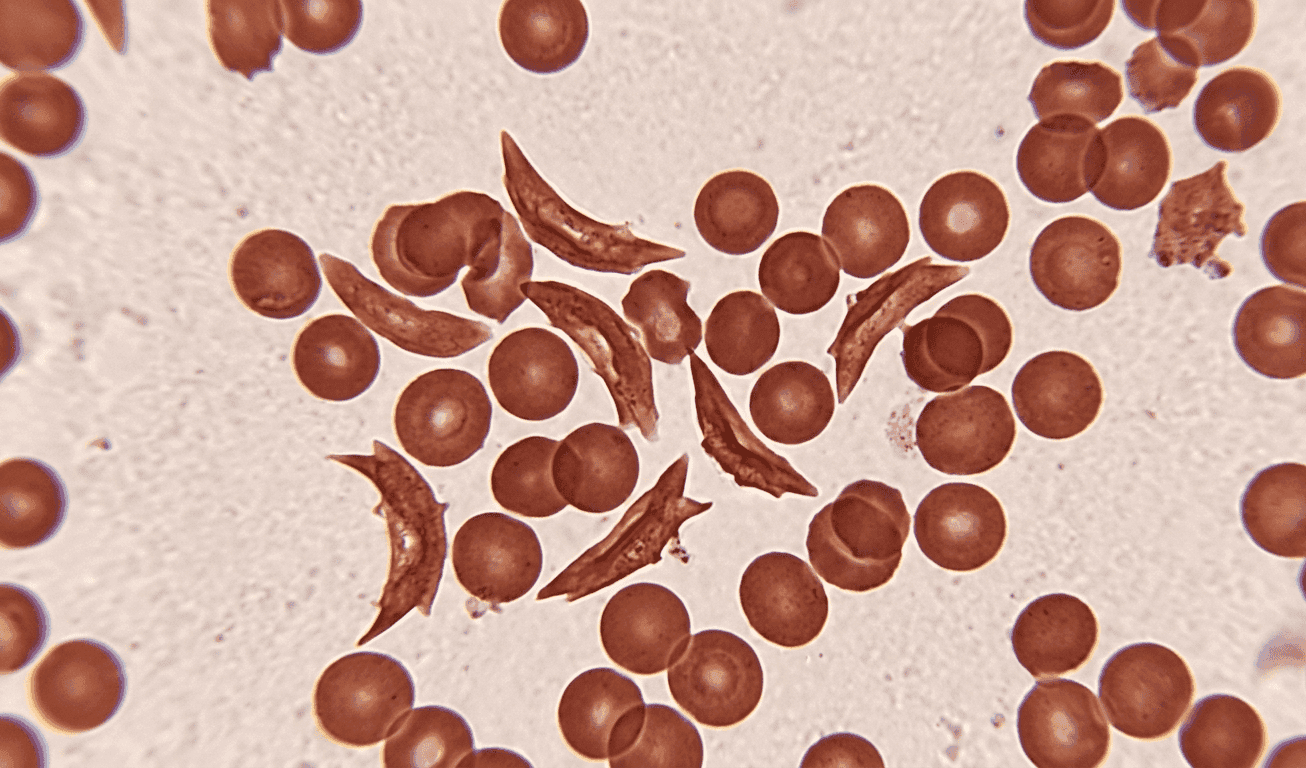
When the words “sickle cell” come up in a conversation, fear often follows.
The sickle cell trait and sickle cell disease share a name and a gene, but they are categorically different conditions with very different health implications.
This article provides a thorough, fact-based breakdown of both conditions: what they are, how they differ at the genetic and clinical level, what complications to be aware of, how screening and testing work, the latest treatment breakthroughs, and what every person carrying either condition needs to know.
In 2021, approximately 515,000 babies were born globally with sickle cell disease, a 13.7% increase from 2000, with sub-Saharan Africa accounting for nearly 80% of cases.
Many of those families had no accurate understanding of what they carried before conception. This guide changes that.
Watch: Sickle Cell Disease: Genetics, Pathophysiology and Treatment
A clear explainer on sickle cell genetics and disease mechanism
What Is the Core Difference Between Trait and Disease?
Sickle cell disease (SCD) results from inheriting the HbS gene from both parents. All or most of the body's haemoglobin becomes Haemoglobin S, which causes red blood cells to harden and assume a rigid crescent shape under low-oxygen conditions.
These sickled cells live only 10-20 days compared to 90-120 days for healthy cells. They block blood vessels, causing severe pain crises, strokes, organ damage, and chronic anaemia.
Key Facts About Sickle Cell Disease
- Approximately 100,000 people in the United States have sickle cell disease.
- Globally, an estimated 510,000 infants are born with sickle cell disease each year, with projections suggesting this number may reach 400,000 by 2050.
- 1 in 365 African American babies is born with sickle cell disease.
- 1 in 16,300 Hispanic American babies is born with sickle cell disease.
- SCD is most prevalent among people of sub-Saharan African, South Asian, Middle Eastern, Mediterranean, and Hispanic descent.
- Normal red blood cells live approximately 120 days. Sickle cells live only 10–20 days, causing chronic hemolytic anemia.
- SCD is an autosomal recessive disorder; both copies of the relevant gene must be abnormal for the disease to manifest.
Sickle cell trait (SCT) results from inheriting one HbS gene and one normal HbA gene. Because normal haemoglobin is present in a greater proportion (typically 57-60% HbA vs. 35-40% HbS), red blood cells function adequately in virtually all everyday circumstances. SCT is a carrier state. People with SCT don't have SCD and cannot develop it.
Key Facts About Sickle Cell Trait
- More than 100 million people worldwide have the sickle cell trait.
- Approximately 2–3 million Americans carry the sickle cell trait.
- About 1 in 13 African American babies is born with the sickle cell trait.
- 8–10% of African Americans carry the sickle cell trait.
- The sickle cell trait also affects people of Hispanic, South Asian, Middle Eastern, and Southern European descent.
- Sickle cell trait NEVER converts into sickle cell disease. It is determined at birth by genetics and does not change.
- People with SCT have a normal life expectancy identical to the general population.
- For every one person with sickle cell disease in the United States, approximately 20 are carriers of the trait.

Understanding the Genetics: How Are These Conditions Inherited?
Both sickle cell trait and sickle cell disease stem from mutations in the HBB gene on chromosome 11, which codes for the beta-globin chain of hemoglobin.
The inheritance pattern follows autosomal recessive principles, meaning that the outcomes depend on which versions of the gene each parent passes on.
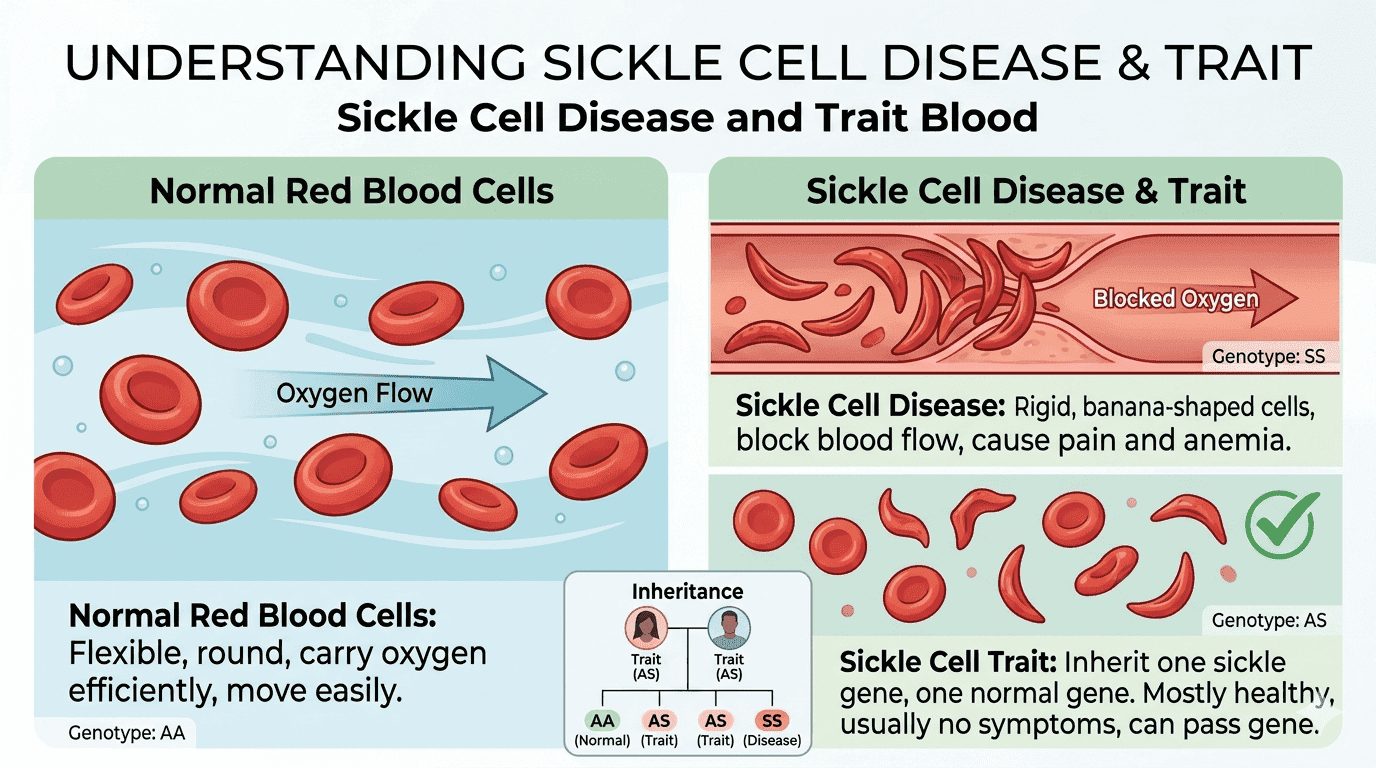
If Both Parents Have Sickle Cell Trait (HbAS x HbAS)
Each pregnancy carries the following statistical probabilities:
• 25% chance the child has sickle cell disease (HbSS)
• 50% chance the child has sickle cell trait (HbAS)
• 25% chance the child has entirely normal hemoglobin (HbAA)
If One Parent Has Sickle Cell Disease and the Other Has the Trait
• 50% chance the child has sickle cell disease
• 50% chance the child has sickle cell trait
If Only One Parent Has Sickle Cell Trait
• 50% chance the child inherits the trait
• 50% chance the child has normal hemoglobin
• 0% chance the child develops sickle cell disease
These probabilities apply to each pregnancy independently.
Understanding your own genetic status is essential for family planning, which is why genetic counseling is strongly recommended for couples where one or both partners carry the trait or the disease.
For a full genotype compatibility guide covering AA, AS, SS, AC and SC pairings [Understanding Your Genotype]
Testing Tip
If you have not been tested and are of African, Hispanic, Middle Eastern, Mediterranean, or South Asian descent, ask your doctor about sickle cell screening. Many people with sickle cell trait do not know they carry it. Knowing your status is essential for informed family planning and appropriate medical precautions.
Living With Sickle Cell Trait vs. Sickle Cell Disease
Living With Sickle Cell Trait
For the overwhelming majority of people, living with sickle cell trait means living a completely normal, healthy life.
Exercise, sports, and physical activity are safe when appropriate precautions are taken; several professional athletes are known carriers of SCT.
The most important things are awareness, informed self-care, and having open conversations with healthcare providers.
The psychological burden of being a “carrier” can be significant, particularly when it comes to family planning.
Genetic counseling provides invaluable support for individuals and couples navigating decisions about pregnancy.
Living With Sickle Cell Disease
Sickle cell disease is a chronic, life-altering illness that requires consistent medical management.
Pain crises, hospitalizations, and complications can significantly disrupt education, employment, and relationships.
The psychosocial burden is substantial, and mental health support is an often-underappreciated component of comprehensive SCD care.
With optimal medical management, including newer disease-modifying therapies, and ideally access to curative gene therapy, the outlook for people living with SCD has improved meaningfully.
Life expectancy, though still reduced compared to the general population in many settings, continues to improve as treatment advances.
Support organizations such as the Sickle Cell Disease Foundation offer resources including patient advocacy, provider directories, and free counseling for individuals and families affected by sickle cell conditions.
Key Takeaways
- Sickle cell trait (SCT) is a carrier state. Sickle cell disease (SCD) is a chronic illness. They are not the same condition, and a trait never converts into disease.
- Approximately 515,000 babies were born globally with SCD in 2021, with sub-Saharan Africa carrying nearly 80% of that burden (GBD Study 2021 / WHO, 2024).
- Most people with SCT lead entirely normal lives, but the condition carries specific, underreported risks, including renal medullary carcinoma (RMC), splenic infarction, and exertional rhabdomyolysis.
Know your genotype. Track your health. The Eloheh app is available on iOS and Android.
This article is for educational purposes only and does not constitute medical advice. Always consult a qualified haematologist or healthcare provider for personal medical decisions.