
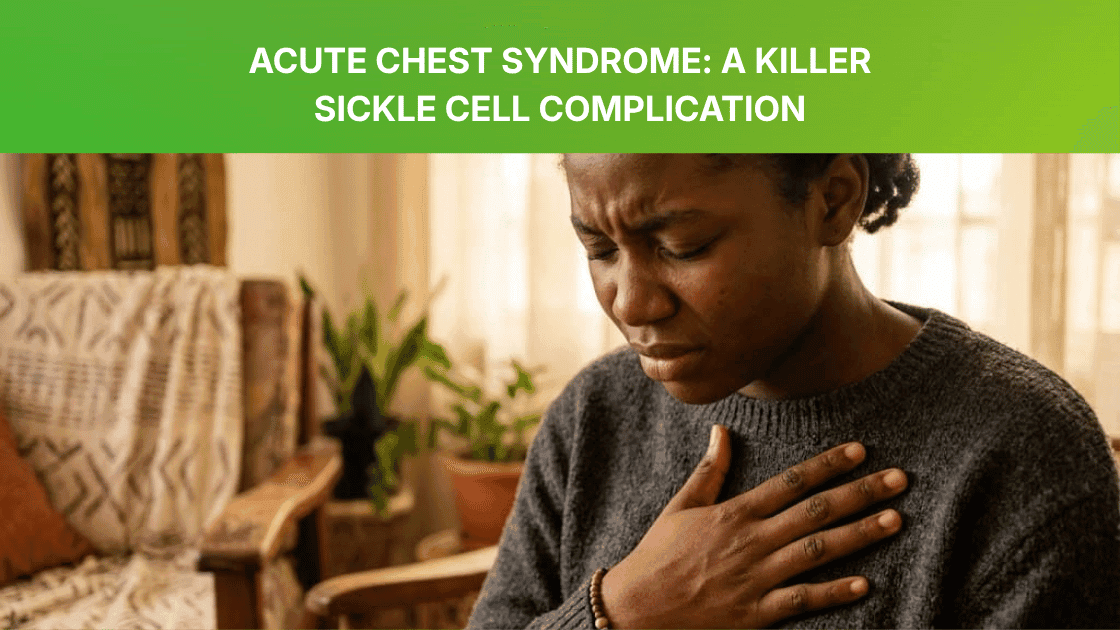
There is a sickle cell complication that kills more patients than almost any other, and most people living with the disease have never been clearly told what it looks like in its earliest stage.
Acute chest syndrome, a serious lung complication, is responsible for roughly 25% of all sickle cell deaths worldwide, according to the Cooperative Study of Sickle Cell Disease.
In adults, it is four times more lethal than it is in children. Yet its early signs, chest pain, a new cough, and a mild fever look so much like a chest cold that patients and families routinely wait too long before getting help. Understanding what it is, what causes it, and how to catch it early can be the difference between a hospital stay and a fatal outcome.
Key Takeaways
- Acute chest syndrome causes roughly 25% of all sickle cell deaths
- Its early signs look almost identical to a common chest infection
- It often develops during or immediately after a pain crisis
- Adults face a higher mortality risk than children despite lower incidence
- Daily management, hydration, and breathing exercises meaningfully reduce your risk
What Is Acute Chest Syndrome?
Acute chest syndrome is a dangerous lung complication that accounts for roughly 25% of all deaths in sickle cell disease, making it the leading cause of death in adults with the condition (CSSCD, Blood 1994). It occurs when sickled red blood cells block the tiny blood vessels inside the lungs, preventing oxygen from transferring properly into the bloodstream. When the lungs cannot deliver enough oxygen, the rest of the body suffers quickly, which is why the speed of response matters so much.
Think of the lungs as millions of tiny air sacs surrounded by even tinier blood vessels. In sickle cell disease, the distorted red blood cells can get stuck in those vessels and block oxygen transfer. The longer the blockage goes untreated, the more lung tissue is starved of oxygen. In severe cases this can spiral into respiratory failure within hours.
Acute chest syndrome accounts for roughly 25% of all sickle cell deaths and is the leading cause of death in adults with the disease.
Children have a peak incidence of 25.3 episodes per 100 patient-years between ages 2 and 4, while adult incidence is lower at 8.8 per 100 patient-years but carries a significantly higher mortality rate.
Why Is It More Dangerous in Adults Than in Children?
Children and adults experience acute chest syndrome through different triggers and with different outcomes. In children, the most common cause is a respiratory infection from a virus or bacteria, and while the episode is serious, children tend to recover better and faster.
In adults, the leading trigger is fat released from bone marrow that has been damaged during a pain crisis. This fat travels through the bloodstream and gets trapped in the lungs, causing a more severe and faster-progressing form of acute chest syndrome.
This means adults often develop the condition not as a standalone event but as a complication that appears during or just after a pain crisis. The transition is easy to miss. The bone pain gets treated while the lungs are quietly deteriorating.
By the time the respiratory symptoms become obvious, significant damage may already be done. This overlap between a pain crisis and developing acute chest syndrome is one of the main reasons the complication is still underdiagnosed.
What Are the Early Warning Signs?
Signs That Are Easy to Dismiss
The early signs of acute chest syndrome are chest pain, a new cough, a fever, and shortness of breath. None of these sounds immediately alarming, especially in someone who already lives with sickle cell pain every day because a cough feels like a cough. Chest tightness feels like a normal pain episode that has moved to the chest area, and this is precisely the problem.
In children, the signals are even more subtle. A child may breathe slightly faster than usual. They may refuse to take deep breaths because it hurts and become unusually quiet or pull inward. In a child who already has a chronic illness, they are especially easy to attribute to tiredness, a cold, or general unwellness. But in a child with sickle cell disease, any combination of these signs deserves immediate medical attention.

The Window Between Warning and Crisis
The period between the first signs of acute chest syndrome and a full respiratory crisis can be very short, sometimes just a few hours. This is the window that determines outcomes, and patients who seek care early in the progression of acute chest syndrome have significantly better survival rates than those who arrive after their oxygen levels have already dropped severely.
One of the simplest and most well-evidenced ways to reduce the risk of acute chest syndrome developing during a pain crisis is a technique called incentive spirometry. This involves doing breathing exercises using a small device that encourages the lungs to expand fully.
A landmark randomised controlled trial (Bellet et al., New England Journal of Medicine, 1995) found that using an incentive spirometer regularly during a pain crisis significantly cut the development of new lung complications. It costs almost nothing and requires no prescription. Deep, deliberate breathing during a pain crisis is one of the most accessible interventions available.
Incentive spirometry used regularly during a sickle cell pain crisis significantly reduces the development of new pulmonary infiltrates and oxygen level drops.
What Triggers Acute Chest Syndrome?
Several things can set off an episode. In children, respiratory infections caused by viruses or bacteria are the most common trigger. In adults, the release of fat from bone marrow that has been damaged during a pain crisis is the leading cause. Other triggers include blood clots in the lungs and breathing too shallowly during a pain crisis, which allows parts of the lung to partially collapse.
Shallow breathing is often a reflex response to chest or rib pain during a crisis, but those small, guarded breaths are actively increasing the risk of acute chest syndrome. Patients who breathe deeply and regularly during pain episodes, even when it hurts to do so, are protecting their lungs. This is why breathing exercises during a crisis are not a passive wellness activity but a medical intervention.

During an episode of acute chest syndrome, blood vessels inside the lung tissue become blocked by sickled red cells, by fat particles from damaged bone marrow, or by clots. Oxygen cannot pass from the air sacs into the bloodstream as it should, and the body responds by increasing breathing rate and heart rate to compensate, but if the blockage is widespread, these responses are not enough.
Inflammation plays a major role alongside the blockage itself. The damaged tissue and blocked vessels trigger an immune response that causes swelling inside the lungs. That swelling further reduces breathing space and oxygen transfer, and in the most serious cases, significant portions of one or both lungs can stop functioning adequately, requiring intensive medical support.
How Can Daily Management Reduce Your Risk?
Acute chest syndrome is not fully preventable, but its frequency can be meaningfully reduced through consistent daily habits. Staying well hydrated is one of the most accessible tools available, because dehydration thickens the blood and makes sickling more likely. Also, staying warm, avoiding sudden cold exposure, and addressing respiratory infections promptly all reduce the risk of a lung complication developing.
Addressing the underlying biology of sickle cell disease through natural and nutritional management also supports crisis reduction overall, including acute chest syndrome. Healingblendsglobal.com contains evidence-grounded content on supplement and nutritional strategies specifically relevant to sickle cell disease. It is worth reading alongside your regular care.
Tracking your symptoms consistently is also one of the most practical things you can do. The Eloheh app lets you log symptoms, moods, and potential triggers daily, giving you and your care team a clearer picture of your patterns. Early recognition of a combination of chest pain, cough, and fever should always prompt immediate medical contact.

Frequently Asked Questions
What is acute chest syndrome in sickle cell disease?
Acute chest syndrome is a serious lung complication that occurs when sickled red blood cells block the blood vessels inside the lungs, preventing oxygen from reaching the bloodstream properly. It causes chest pain, fever, cough, and reduced oxygen levels in the blood. It is responsible for roughly 25% of all sickle cell deaths and is the leading cause of death in adults with the disease.
What are the early warning signs of acute chest syndrome?
Early warning signs include chest pain, a new or worsening cough, fever, and shortness of breath. In children, signs are often more subtle: faster breathing than usual, reluctance to breathe deeply, unusual tiredness, and reduced appetite. Any combination of these signs in a person with sickle cell disease requires urgent medical attention.
What triggers acute chest syndrome?
In children, respiratory infections are the most common trigger. In adults, fat released from bone marrow damaged during a pain crisis is the leading cause. Other triggers include blood clots in the lungs and shallow breathing during a pain crisis, which can cause parts of the lung to partially collapse. Staying well hydrated and breathing deeply during a crisis reduces these risks.
How is acute chest syndrome different from a regular sickle cell pain crisis?
A standard pain crisis usually involves bone, joint, or abdominal pain without directly affecting the lungs. Acute chest syndrome specifically involves the lungs and is identified by respiratory symptoms alongside chest pain and falling oxygen levels. It often develops during or just after a pain crisis, meaning the two can overlap and the transition can be missed.
This article is for educational purposes only and does not constitute medical advice. Always consult a qualified haematologist or healthcare provider for personal medical decisions.
elohehkits.com | @elohehkits