
If you've ever filled out a form at a hospital, sat through a premarital counselling session, or been asked by a partner, "What's your genotype?", you already know this topic is extremely important. But for most people, the answer doesn't go much deeper than reciting letters they were told at some point in the past.
This guide changes that. Whether you're AA, AS, SS, AC, or SC, knowing what those letters actually mean is one of the most important things you can do for yourself and the family you may one day build.
By the end of this piece, you'll understand exactly what each genotype means, the health implications it carries, how combinations interact when couples plan families, and what practical steps to take next.
▶ Watch: Sickle Cell: Natural Selection in Humans (HHMI BioInteractive)
An excellent animated explainer on how the sickle cell gene spread through malaria-endemic populations, the evolutionary story behind why genotype matters today.
What Is a Genotype? Why Does It Matter?
According to the Centre for Policy Impact in Global Health (2024), approximately 150,000 babies are born with sickle cell disease in Nigeria each year, accounting for roughly a third of all new cases globally. Every single one of those births results from a predictable, testable combination of haemoglobin genes passed from parent to child. That combination is a genotype.
More precisely, in this context, your genotype refers to the pair of haemoglobin genes you inherited, one from your biological mother and one from your biological father.
Haemoglobin is the protein inside red blood cells that carries oxygen from the lungs to every organ in the body. Normal haemoglobin is called haemoglobin A (HbA). Through genetic mutation, two abnormal variants exist that drive sickle cell disease: haemoglobin S (HbS) and haemoglobin C (HbC).
Why does this matter so much? Unlike most health conditions that develop over time due to lifestyle, environment, or age, your genotype is fixed from the moment of conception. No diet, medication, or lifestyle change can alter it. It determines not only your own health profile but also the potential health of every child you conceive.
The Five Main Genotype Types Explained
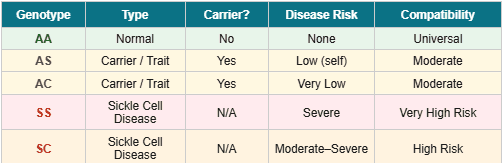
Five haemoglobin genotypes are most commonly discussed in clinical and public health settings. Each has a distinct biological profile, a different health outlook, and specific implications for family planning.
AA: The Normal Genotype
People with the AA genotype have inherited two copies of the normal haemoglobin gene, one A from each parent. Their red blood cells are healthy, round, and flexible. They move easily through blood vessels, carry oxygen efficiently, and don't sickle under any condition.
An AA person can only pass the A gene to a child. So regardless of a partner's genotype, no child of two AA parents will ever develop sickle cell disease.
AS: The Sickle Cell Carrier (Sickle Cell Trait)
The AS genotype is among the most important to understand, particularly in West Africa, where it's extremely common. AS individuals carry one normal haemoglobin gene (A) and one sickle haemoglobin gene (S). Under normal circumstances, they live entirely healthy lives.
Their red blood cells contain a mix of HbA and HbS, with HbS levels typically below 40%. That's not enough to trigger the painful crises experienced by people with the SS genotype.
Unique Insight: Scientific evidence strongly suggests that AS individuals have a natural survival advantage against severe malaria. The sickle haemoglobin gene inhibits the Plasmodium parasite's ability to thrive inside red blood cells, which is the primary reason the sickle cell gene became so prevalent in malaria-endemic regions. It was, in evolutionary terms, a life-saving adaptation that spread through populations over thousands of years.
▶ Watch: Sickle Cell Disease Animation (Alila Medical Media)
A clear animated overview of sickle cell disease genetics, pathophysiology, and treatment, ideal for sharing with patients or family members.
AC: The Haemoglobin C Carrier
The AC genotype, one normal A gene and one haemoglobin C gene, is less commonly discussed but medically important. Haemoglobin C results from a specific mutation in the HBB gene: a substitution of the amino acid glutamic acid for lysine, distinct from the HbS mutation. AC individuals generally live healthy, asymptomatic lives.
The C gene doesn't cause red blood cell sickling. Some AC individuals develop very mild anaemia, but the quality of life is typically unaffected. Medical experts describe AC as a benign carrier state.
The complexity arises with family planning. An AC individual who has children with an AS partner faces a 25% chance per pregnancy of producing an SC child, who will have SC disease. Because AC produces no symptoms, it often goes undetected until an SC child is born. This is exactly why testing matters for everyone, not only those who appear unwell.
Did You Know? The AC genotype is rarer than AS in most Nigerian populations, and because it produces no obvious symptoms, it frequently goes undetected. Many people discover their AC status only after a child is born with SC disease.
SS: Sickle Cell Disease (Most Severe Form)
A person with the SS genotype has inherited a sickle haemoglobin gene (S) from both parents. All of their haemoglobin is HbS; there's no normal HbA to offset it. This is the most common and most severe form of sickle cell disease.
Haemoglobin S causes red blood cells to become rigid and assume a crescent or 'sickle' shape, particularly when blood oxygen levels drop. These abnormally shaped cells live only 10–20 days, compared to 90–120 days for healthy cells. They also lodge in small blood vessels, blocking blood flow and oxygen delivery to tissues and organs.
This blockage drives the hallmark symptom of sickle cell disease: the vaso-occlusive crisis, episodes of severe acute pain affecting bones, the chest, the abdomen, and joints that can last hours or days, frequently requiring hospitalisation and strong pain management.
SC: Haemoglobin SC Disease
SC disease occurs when a person inherits one sickle haemoglobin gene (S) from one parent and one haemoglobin C gene (C) from the other. It's the second most common form of sickle cell disease after SS.
SC disease is often described as 'milder' than SS. That characterisation has some clinical basis; SC individuals do experience vaso-occlusive crises, anaemia, and organ damage, generally less frequently than those with SS. But the condition remains a serious, chronic, life-altering diagnosis. And SC carries one category of complication that's actually worse than SS.
Unique Insight: SC is not the sickle cell trait. SC individuals have sickle cell disease. They should never be confused with AS carriers.
Genotype Compatibility: The Complete Guide for Couples
Understanding genotype compatibility is the most practically urgent part of this guide. Haemoglobin inheritance follows simple, predictable genetic laws, which means that with the right knowledge, a significant proportion of sickle cell disease cases are entirely preventable.

How to read this table: Each row shows independent probabilities per pregnancy. A previous healthy child does not reduce the statistical risk for the next. A couple who has already had an AA child faces the same 25% SS risk in every subsequent pregnancy, one of the most consequential misunderstandings in SCD genetics counselling.
When Should You Get Tested?
- Before entering a serious romantic relationship or contemplating marriage
- Before pregnancy, as part of preconception care
- During pregnancy, if not previously tested, so that genetic counselling can begin promptly
- After receiving an uncertain or conflicting result from a previous test
- In childhood, as early as possible after birth, as part of neonatal screening
Your Genotype Is Your Responsibility
Whether you're AA, AS, SS, AC, or SC, your genotype is one of the most important pieces of health information you'll ever carry. It connects your past (the genes you inherited), your present (your own health profile), and your future (the children you may have and the genetic legacy you pass on).
Get tested. Know your genotype.
Use Eloheh to track your health and to find a health institutions near you, wherever you are in the world.
Frequently Asked Questions (FAQs)
Can two AS people marry?
No, two AS adults are not advised to marry. Each pregnancy carries a 25% chance of an SS child, a probability that doesn't shrink after a healthy baby is born. The decision is deeply personal. What it can never safely be is uninformed.
Is AA compatible with every genotype?
An AA individual can only pass the A gene to a child. So even with an AS or AC partner, none of their children will have sickle cell disease. The only scenario involving any concern: partnering with an SS individual means all children will be AS carriers. None will have the disease.
Can genotype change over time?
No. Genotype is fixed at conception and stays that way for life. If you receive conflicting results from different laboratories, request a repeat test at an accredited facility, ideally a government teaching hospital or specialist haematology centre. Errors in genotype testing, whether accidental or deliberate, are a documented public health problem in Nigeria.
What about AS + AC couples?
They cannot marry. This pairing is very risky. In each pregnancy, there's a 25% chance of an SC child (who will have SC disease) and a 25% chance of an AS carrier. Genetic counselling is strongly advised.
How early should children be tested?
Newborn screening is the ideal. In Nigeria, newborn screening is available in some hospitals and through NGO programmes, though a universal national programme is not yet in place. Testing in early childhood, well before any reproductive decisions are made, should be the baseline standard.
This article is for educational purposes only and does not constitute medical advice. Always consult a qualified haematologist or healthcare provider regarding your personal genotype, health management, and family planning decisions.
elohehkits.com | @elohehkits