
"You have sickle cell trait. It's nothing to worry about."
That's what millions of people around the world hear when they get their genotype results. And for the most part, it's true; carriers live normal, healthy lives without any symptoms.
But here's what most doctors don't follow up with: under very specific conditions, your body can respond differently from someone who doesn't carry the trait.
This isn't about panic. It's about being properly informed. The science on this has been building for years, and it's time more carriers had access to it in plain language.
Key Takeaways
- More than 300 million people globally carry sickle cell trait (HbAS), yet most are only told "you're a carrier, you're fine", with no further guidance.
- Research published in the New England Journal of Medicine found that HbAS soldiers had a 54% higher risk of exertional rhabdomyolysis (severe muscle breakdown) compared to non-carriers under intense physical stress.
- The risk is not daily. It appears mainly under specific conditions: extreme heat, dehydration, and very intense physical exertion.
- Knowing your genotype is the first step. If you don't know yours, get tested with the Eloheh rapid test kit, results in 15 minutes.
What Is Sickle Cell Trait, Really?
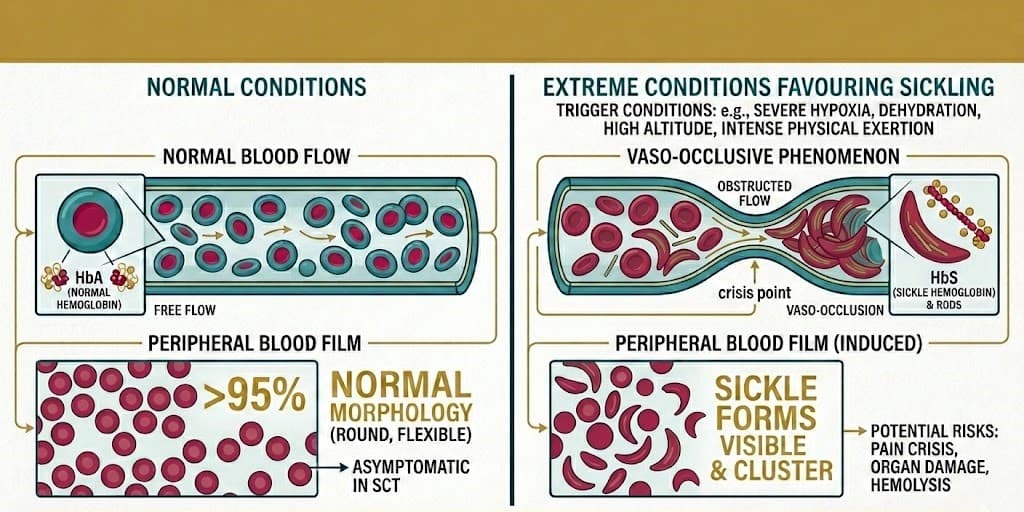
Sickle cell trait (written as HbAS) means you inherited one normal hemoglobin gene from one parent and one sickle hemoglobin gene from the other. You are not sick. You do not have sickle cell disease. Your blood generally works the way it's supposed to.
Think of it like this: your body has two instruction manuals for making red blood cells. One manual says "make normal cells." The other says "make sickle cells." Because you have the normal one too, your body mostly makes normal cells and keeps you healthy.
What this is NOT:
- It is not sickle cell disease
- It is not something that gets worse over time
- It does not require daily treatment or medication
- It does not usually cause pain or tiredness in normal daily life
What it is:
- A genetic carrier state that you can pass on to your children
- A condition that is mostly silent under normal conditions
- Something that can matter under extreme physical or environmental stress
The real problem isn't what sickle cell trait does to your body daily. It's the fact that most carriers are never told what it can mean in specific situations. That information gap is what we're here to close.
What Happens to Your Muscles During Extreme Exercise?

This is where the science gets important. A large study published in the New England Journal of Medicine looked at nearly 48,000 Black soldiers in the U.S. Army over four years. The researchers found that soldiers with sickle cell trait had a 54% higher risk of exertional rhabdomyolysis compared to those without it, even after accounting for other risk factors.
Rhabdomyolysis is a condition where muscle fibers break down very rapidly during extreme physical activity. The breakdown releases proteins into the bloodstream that can, in serious cases, overwhelm the kidneys.
Now, what triggers this in someone with sickle cell trait?
When you push your body very hard, especially in heat or without enough water, red blood cells are put under stress. In carriers, this stress can sometimes cause some of those sickle-shaped cells to clump and block tiny blood vessels in the muscles, slowing oxygen delivery exactly when muscles need it most.
The situations most linked to this risk are:
- Military-style drills or training camps with forced-pace running
- Long-distance endurance events, especially in heat
- Football and athletic training where players push past exhaustion
- Sudden, very intense exercise without building up fitness gradually
The American Society of Hematology published a systematic review in 2025 noting there is no evidence that everyday exercise causes serious harm in sickle cell trait carriers.
The risk appears specifically when multiple stressors happen together: extreme intensity, heat, and dehydration at the same time.
According to a 2024 study published in the journal Genes, sickle cell trait is "a risk factor for exertional rhabdomyolysis, a rare but potentially fatal consequence of highly intense physical exercise, particularly among active-duty military personnel and high-performance athletes" (PMC, 2024).
Why Does Staying Hydrated Matter More Than You Think?
Dehydration is one of the clearest risk factors for carriers, particularly during intense activity or hot weather. When you're dehydrated, your blood becomes thicker, your body temperature climbs faster, and your red blood cells are working harder with less support.
For someone with sickle cell trait, this creates a window where the sickle-shaped cells are more likely to cause problems, slowing blood flow in small vessels under physical pressure.
Warning signs that something isn't right during exercise include:
- Sudden, unusual fatigue that doesn't ease up
- Muscle pain that feels different from normal soreness
- Dizziness or overheating that doesn't pass with rest
- Inability to continue activity despite wanting to
These signs don't mean you have sickle cell disease. They mean your body is telling you to stop and recover.
Some simple habits that lower the risk significantly:
- Drink water before, during, and after exercise, not only when you feel thirsty
- Build fitness gradually rather than jumping into intense training
- Take rest breaks during high-intensity activity, especially in heat
- Avoid exercising in extreme heat without proper acclimatization
Awareness here doesn't mean fear. It means smarter choices. Exercise is healthy and encouraged for the vast majority of HbAS carriers.
Can Sickle Cell Trait Affect Blood Clot Risk?
This is something very few carriers ever hear about. Some large population studies have found a modest increase in the risk of venous thromboembolism (VTE) in people with sickle cell trait. VTE refers to blood clots, particularly deep vein thrombosis (DVT, a clot in the leg) and pulmonary embolism (PE, a clot in the lungs).
The estimated increase in risk is modest, ranging from approximately 1.3 to 1.5 times the baseline risk, and tends to be more associated with pulmonary embolism than DVT alone. Importantly, sickle cell trait is not classified as a blood clotting disorder, and most carriers will never experience a clot.
But this becomes worth knowing in certain situations, including:
- Long-haul flights (sitting still for many hours)
- Recovery from surgery, where movement is limited
- Periods of extended bed rest or illness
- When using hormonal therapies, which already carry some clot risk
For most carriers, the action item here is awareness, not alarm. Staying mobile, staying hydrated, and knowing your genetic status are the most practical steps.
What About High Altitude? Does That Matter for Carriers?
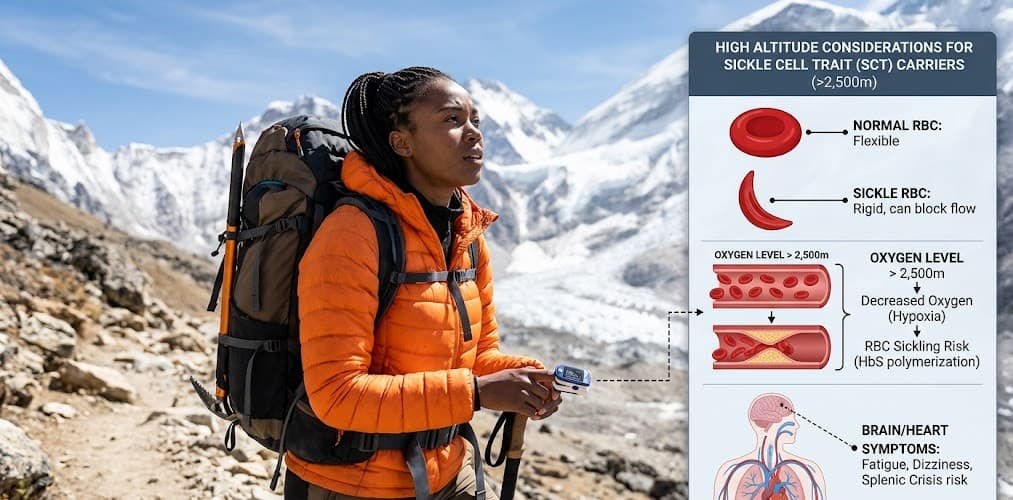
Altitude is one of the most striking examples of how environment can affect sickle cell trait carriers in ways that would never show up in daily life at sea level.
At high altitude (generally above 2,500 to 3,000 metres), there's less oxygen in the air. This puts the red blood cells under what doctors call "hypoxic stress"; they're being asked to carry oxygen when there's less of it available. For someone with HbAS, this occasionally triggers a rare complication called 'splenic infarction', where a small portion of the spleen loses its blood supply temporarily.
Symptoms include sudden pain on the upper left side of the abdomen, nausea, and fatigue. The tricky part is that these symptoms are often mistaken for altitude sickness, a stomach problem, or muscle strain — so it goes unrecognized until further tests are done.
This is not common. Most people with sickle cell trait travel to high altitudes without any issues. But if you're planning high-altitude travel, knowing your genotype is useful information to share with a doctor beforehand.
What About Your Kidneys?
The kidneys have some of the most oxygen-demanding tissue in the body, particularly the inner part (called the medulla). Research suggests that in HbAS carriers, this area can sometimes show subtle effects, including occasional blood in the urine and a reduced ability to concentrate urine.
These effects are generally mild and don't lead to kidney disease in most carriers. But they're worth knowing about, particularly if a doctor is trying to work out unexplained symptoms.
If you ever notice blood in your urine, especially after intense exercise, it's worth mentioning your carrier status to your doctor. This is not cause for alarm, but it gives your healthcare provider important context.
The Bigger Picture: What Sickle Cell Trait Means for Starting a Family
This is where sickle cell trait becomes most important — not for your own daily health, but for the children you may have.
If both you and your partner carry sickle cell trait (both AS), there is a 25% chance with every pregnancy that your child will be born with sickle cell disease (SS). That's one in four children. This is not a small risk, sickle cell disease is a serious, lifelong condition that affects every part of the body.
This is why we at Eloheh say it plainly: two people who both carry sickle cell trait should not have children together. The risk is too high and too real.
The only way to know your genotype before marriage or having children is to get tested. Don't guess. Don't assume. Don't rely on someone else's memory of what they were told years ago
Eloheh makes this easy. Our rapid test kit gives you results in 15 minutes with 99.5% accuracy. No hospital visit. No waiting days for a lab result.
Not sure what the different genotypes mean? Read our full guide: Understanding Your Genotype: AA, AS, SS, AC, SC Explained.
Can Anything Support Your Body as an HbAS Carrier?
For most carriers, the answer to daily health is simply: live well, stay hydrated, and be aware of the risk scenarios above.
But if you carry sickle cell trait and want to support your overall health naturally, nutrition and supplementation are worth understanding. The team at Healing Blends Global, led by Dr. Charlie Ware, a natural medicine physician who has worked extensively with the sickle cell community, has written in depth on natural approaches to circulatory health and blood cell support.
Head over to the Healing Blends blog and read their research-backed articles on sickle cell disease and natural health management. Whether you're a carrier looking to stay well or someone supporting a family member with sickle cell disease, their content is worth reading.
For those managing sickle cell disease (SS or SC), natural anti-inflammatory and circulatory support plays an important role alongside regular medical care. The science behind specific herbs and micronutrients for sickle cell is growing and Healing Blends Global covers this research more thoroughly than most medical websites do. Read their latest sickle cell research coverage here.
So, What Should You Actually Do With This Information?
Knowing you have sickle cell trait doesn't need to change how you live. For most people, life continues as normal. But three things matter:
- Know your genotype officially.
If you haven't been tested with a proper clinical test, get tested. Word of mouth, old memory, or unofficial results are not reliable enough when it comes to family planning decisions. Use the Eloheh rapid test kit for a fast, accurate result you can trust.
- Make sure your partner is tested too.
Before marriage or starting a family, both partners need to know their genotype. This is one conversation that's worth having early. Read more in our article: Family Planning with Sickle Cell: Genetic Testing Before Pregnancy.
- Tell your doctor.
Make sure your carrier status is recorded in your medical history, especially before surgery, before starting any new medications, and if you're planning high-altitude travel or intense athletic training. It's a simple flag that gives your doctor useful context.
If you're tracking symptoms, managing medications, or looking for sickle cell specialists near you, the Eloheh app gives you a complete health management dashboard in your pocket.
The Bottom Line
Sickle cell trait is not a disease. Most carriers live completely normal lives and never face a single complication from it. But "mostly harmless" is not the same as "completely harmless under all conditions".
The real gap is informational. Millions of people carry the sickle cell trait without knowing what it actually means for intense exercise, altitude, or pregnancy.
That knowledge gap costs lives and causes preventable suffering in children born with sickle cell disease.
Know your status. Know your partner's status. Make decisions based on real information.
Frequently Asked Questions About Sickle Cell Trait
Is sickle cell trait (HbAS) the same as sickle cell disease?
No. Sickle cell trait means you carry one sickle gene and one normal gene. Sickle cell disease (HbSS) means you inherited the sickle gene from both parents. Carriers are generally healthy and do not have sickle cell disease. The key concern is what you can pass on to your children.
Can I exercise normally if I have sickle cell trait?
Yes. The American Society of Hematology confirmed in 2025 that normal exercise does not pose a meaningful risk for most HbAS carriers. The risk is specific to extreme intensity combined with heat and dehydration, not regular workouts or sports. Stay hydrated and don't push through unusual pain or exhaustion.
What happens if two people with sickle cell trait (AS + AS) have children?
With every pregnancy, there is a 25% chance the child will have sickle cell disease (SS), a 50% chance of being a carrier (AS) like both parents, and a 25% chance of having no sickle cell gene (AA). We strongly advise AS couples against having children together. Get tested before marriage.
How do I find out if I have sickle cell trait?
Get a genotype test. The Eloheh rapid test kit delivers results in 15 minutes with 99.5% accuracy. No hospital appointment needed. Order here and test at home. You can also read our complete guide to the different genotype results: AA, AS, SS, AC, SC Explained.
Does sickle cell trait affect blood clot risk?
Some research suggests a modest increase in pulmonary embolism risk in HbAS carriers, estimated at 1.3 to 1.5 times the baseline. This is not classified as a clotting disorder. Being aware of the risk during long flights, surgery recovery, or extended immobility is useful practical knowledge.
Can natural supplements help if I have sickle cell trait?
For most carriers, specific supplementation isn't necessary. But supporting general circulatory and immune health through nutrition is always beneficial. Healing Blends Global has published extensive research-based guidance on natural approaches for the sickle cell community. Read their articles here.
Should I tell my future spouse about my sickle cell trait status?
Yes, absolutely. This is not optional information in a relationship where children are a possibility. Both partners need to know their genotype before making decisions about marriage and family. Use the Eloheh test kit to get a confirmed, accurate result to share.
This article is for educational purposes only and does not constitute medical advice. Always consult a qualified haematologist or healthcare provider for personal medical decisions.
elohehkits.com | @elohehkits