
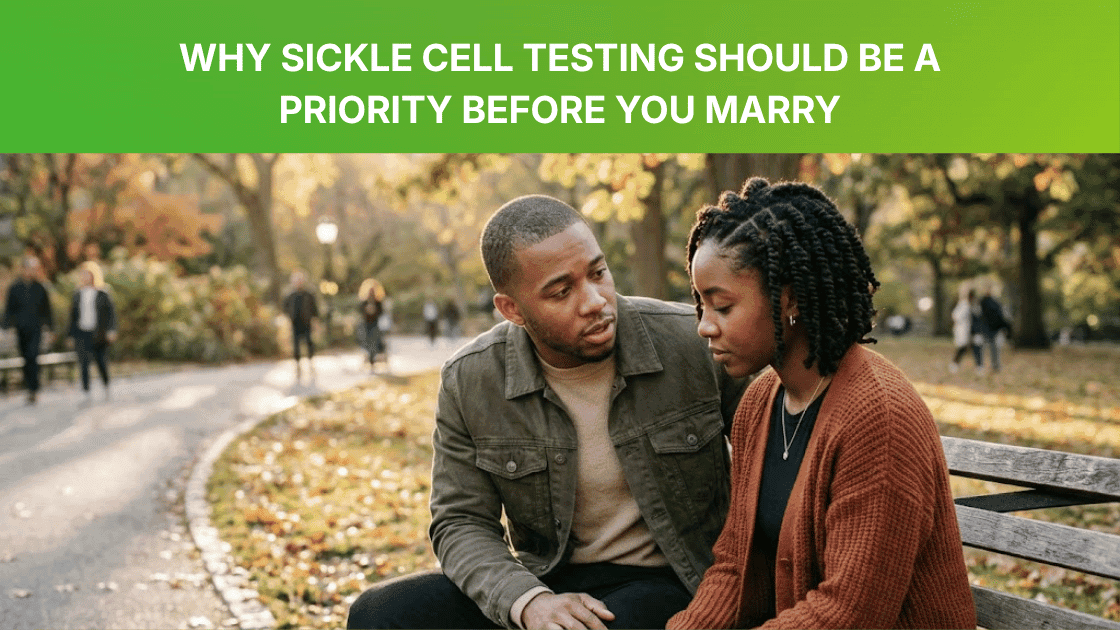
Most guides on sickle cell testing will explain what the condition is and why you should get tested.
This post goes further into what they often leave out: the real decisions, pressures, and consequences that quietly shape lives when testing happens too late or not at all.
Your Genotype Is a Life Decision, Not Just a Medical Label
When you get a sickle cell test, you are not just receiving a letter like AA, AS, or SS. You are getting information that shapes three major areas of your life:
- Who you can safely have children with
- The long-term health risks you may carry without knowing it
- The kind of medical support you should plan for early
Your genotype does not just predict health outcomes. It influences life outcomes.
Early knowledge gives you a real advantage most people only realise once a harder decision is already in front of them.
Being a "Healthy Carrier" (AS) Is More Complicated Than You Are Told
Many people with the AS genotype are often relaxed and are told to have no cause for alarm. That is only half the truth.
What is rarely explained:
- Under some extreme conditions like very low oxygen or severe dehydration, AS individuals can experience complications
- Many AS carriers unknowingly enter relationships with other AS carriers, and every pregnancy between two AS partners carries a 1 in 4 chance of producing a child with SS disease
- In many communities worldwide, genotype conversations are still avoided until it is too late
Our position is clear: If both you and your partner are AS, you should not have children together.
This is not about limiting love. It is about protecting the life of a child who has no say in the matter.
SICKLE CELL GENOTYPE EXPLAINED
When You Test Matters as Much as Whether You Test

Most people are told: "Test before marriage." That is correct but incomplete.
Here is a smarter way to think about the timeline:
- Teenage years (13 to 19): Awareness stage. Learn what your genotype means.
- Early 20s: Decision stage. Relationships are beginning to matter.
- Before any serious commitment: Confirmation stage. Both partners test independently.
By the time many people get tested, emotional investment in a relationship is already deep.
At that point, logic starts negotiating with feelings. Testing early removes that conflict entirely before it starts.
Not All Testing Methods Are Equal

Most people assume all sickle cell tests give the same information. They do not.
Key things to know:
- Some rapid tests only confirm the presence of the sickle gene but cannot distinguish between AS and SS, or detect other variants like SC and AC
- Haemoglobin electrophoresis is the most complete test available. It gives your full genotype, not just a partial picture. Always ask for it by name.
- The Eloheh Rapid Test Kit is designed to provide reliable, accurate results even where laboratory access is limited. It is a strong starting point for testing anywhere in the world. Visit elohehkits.com
Your result is only as reliable as the method used to get it.
Testing Is Also a Financial Decision
This is rarely talked about, but it is real. Raising a child with SS disease involves:
- Regular hospital visits and monitoring
- Medication costs throughout childhood and into adulthood
- Emergency care during crises, which can be unpredictable
Without a strong insurance or healthcare safety net, this becomes a significant long-term financial commitment for the whole family.
Testing before you have children is not just about health. It is a form of financial planning.
For families already managing sickle cell disease, EvenFlo from Healing Blends Global has shown 93% effectiveness at reducing crises in a double-blind peer-reviewed study. Explore the evidence at healingblendsglobal.com.
MANAGING SICKLE CELL DISEASE NATURALLY
The Silence Around Genotype Is Costing Lives

In communities across the world, genotype conversations are still:
- Avoided in relationships
- Seen as unromantic or unnecessary
- Left until after an engagement or pregnancy
Ignoring genotype compatibility does not remove the risk. It only delays the consequence. And the person who pays the highest price for that delay is the child born with the condition.
Normalising these conversations is just as important as the test itself. Start the conversation early, before feelings make it harder.
The Bottom Line
Knowing how to get a sickle cell test is the easy part. Acting on that knowledge before you are emotionally invested in the wrong direction is where most people fall short.
Your genotype is a quiet compass. It does not control your journey, but it tells you where the dangerous paths are before you step onto them.
Get tested. Start at elohehkits.com
Frequently Asked Questions
At what age should I get a sickle cell test?
The earlier the better. Testing in your early to mid-teens gives you time to understand your result and make relationship decisions without emotional pressure.
Before any serious commitment is the absolute minimum. Both partners should test independently, not just one.
Is the AS genotype something I need to worry about?
Yes, if your partner is also AS or AC. On its own, AS/AC does not cause sickle cell disease, and most people with AS/AC live healthy lives. But two AS/AC partners face a 25% risk per pregnancy of having a child with SS disease. Every pregnancy carries that same risk. This is why genotype compatibility conversations must happen before marriage.
What is the most accurate sickle cell test?
Haemoglobin electrophoresis is the most complete test available. It identifies your full genotype, including AS, SS, SC, AC, and other variants. A basic sickling test only confirms whether the sickle gene is present. Always ask specifically for haemoglobin electrophoresis.
The Eloheh Rapid Test Kit is a reliable starting point where full laboratory access is not immediately available.
What support is available for people already living with sickle cell disease?
Healing Blends Global has developed a range of natural, evidence-based supplements specifically for sickle cell disease.
EvenFlo, their flagship product, has shown 93% effectiveness in a double-blind clinical study. Read the research and explore the full range at healingblendsglobal.com.
This article is for educational purposes only and does not constitute medical advice. Always consult a qualified haematologist or healthcare provider for personal medical decisions.
elohehkits.com | @elohehkits