
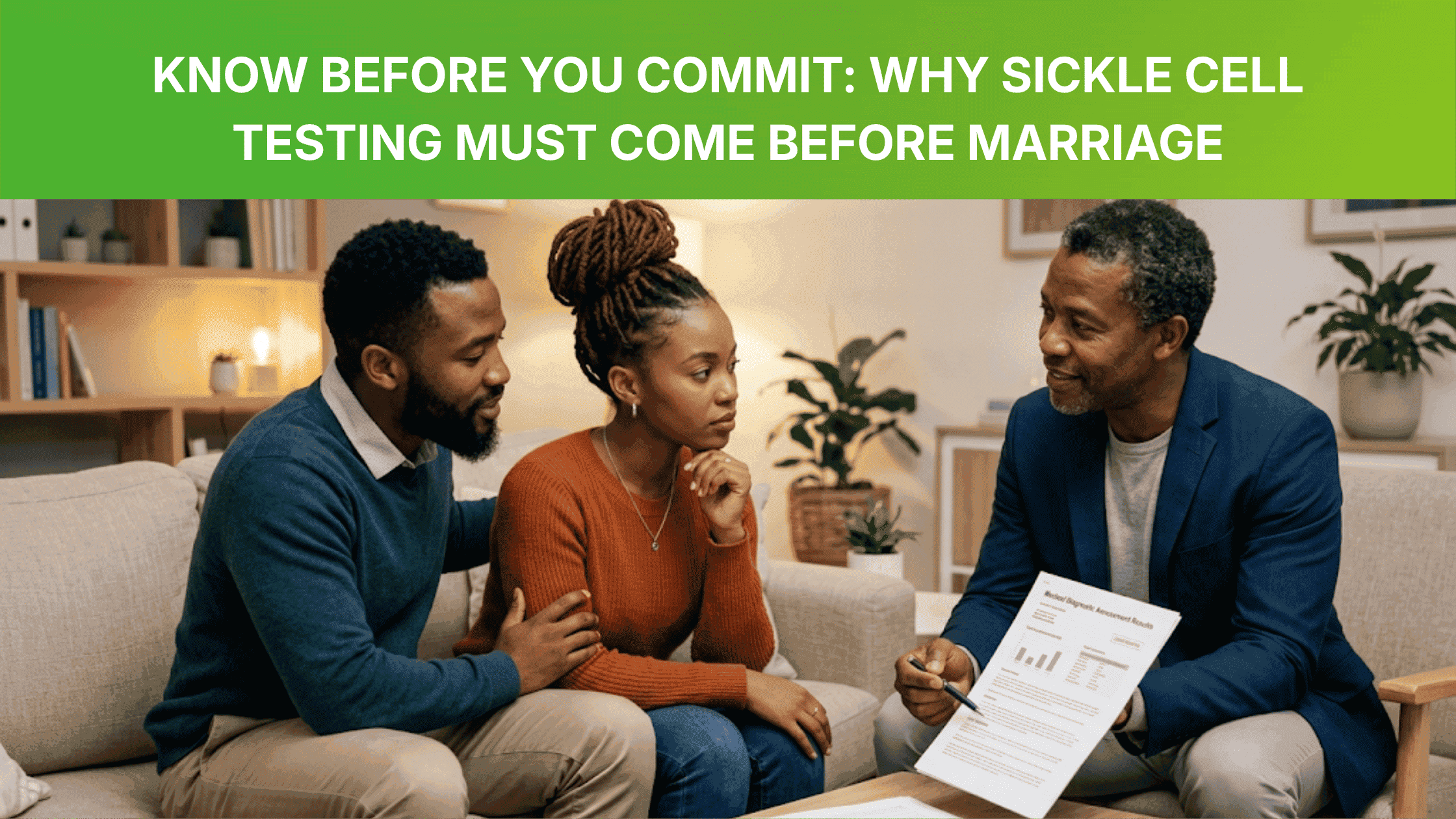
Sickle cell disease is entirely preventable. That is one of the most important things to understand about this condition.
Unlike most serious illnesses, we know exactly how it is passed from parent to child, we can test for it before a pregnancy begins, and people can make fully informed decisions long before they start a family.
Yet children continue to be born with the disease, largely because testing happens too late, or not at all. Globally, about 515,000 babies are born with sickle cell disease every year. Nearly 75% of those births happen in sub-Saharan Africa.
What makes this painful to sit with is that sickle cell disease is one of the few serious genetic conditions where couples can actually know their risk before pregnancy begins and plan accordingly.
This guide breaks it down in plain terms: how it's inherited, what tests to take, what your results mean, and what your real options are.
Key Takeaways
How Does Sickle Cell Disease Get Passed to Children?
Your blood carries a protein called haemoglobin, which moves oxygen around the body. Sickle cell disease happens when a small fault in the gene that makes haemoglobin is inherited from both parents.
That tiny fault turns healthy, round blood cells into stiff, crescent-shaped ones that block blood vessels, cause severe pain, and damage organs over time.
Here is how it works in practice:
- AA: Normal. No sickle gene.
- AS: Carrier (sickle cell trait). Healthy, but carries one faulty gene.
- SS: Sickle cell disease. Has two faulty genes. This is the most severe form.
- SC: Also a form of sickle cell disease. Can cause strokes, eye damage, and serious complications, though it is sometimes less severe than SS.
- AC: Carrier. Healthy, but carries one HbC gene.
The risk only arises when two carriers, or a carrier and someone with the disease, have children together.
If one partner is AA and the other is AS, none of their children will have sickle cell disease (though some may be carriers). But if both partners are AS, every pregnancy carries a 25% chance of producing a child with SS disease. That 25% applies to each and every pregnancy.
HOW SICKLE CELL IS INHERITED
Why You Cannot Rely on What You Think You Know
This is where many people are caught off guard. More than half of young adults of marriageable age do not know their genotype, and many who believe they do know are wrong.
A study among expectant parents in Enugu State, Nigeria, found that only 50% of participants could accurately report their own sickle cell status. Even among those who believed they knew, roughly 1 in 9 were wrong in a way that could directly affect their children.
A family history of "no sickle cell" does not mean no gene was passed on. Symptoms are not present in carriers. There is no visible sign. The only reliable answer is a proper test.
The Eloheh Rapid Test Kit provides reliable, accessible testing that you can use as a starting point. Get tested at elohehkits.com
Our Position on AS x AS Couples Is Clear
If both you and your partner are AS, you should not get married and have children together.
This is not a judgement; it is a scientific reality with lifelong consequences for any child born with SS disease.
Every child born with SS disease faces a lifetime of pain crises, organ damage, hospitalisations, and a life expectancy that is significantly shorter than it should be. No couple should carry that weight, and no child should be born into it when it is entirely preventable.
Get tested. Know your genotype. And choose your partner with that knowledge in hand.
Read more about the full picture of living with sickle cell disease on the Healing Blends
When Should You Get Tested?
The honest answer is as early as possible and certainly before you are emotionally committed to someone. Testing in your teens or early twenties gives you the most clarity and the most freedom.
Do not wait until you are engaged. Do not wait until you are pregnant.
Find out now, so the information shapes your choices rather than complicating them.
Both partners should be tested independently. Never rely on a partner's verbal report or a test they had years ago. And if you are supporting a young person you know, encourage them to get tested. This is one conversation that genuinely saves lives.
The Bottom Line
Sickle cell disease is a lifelong condition. Children born with it face pain, complications, and a shortened life, for something that was entirely preventable.
Testing is simple. The information is available. The decision to find out your genotype before committing to a partner is one of the most important choices you will ever make.
Get tested. Know your status. Marry right.
Frequently Asked Questions
What does it mean to have sickle cell trait (AS)?
Having AS means you carry one copy of the sickle gene, but you do not have the disease. People with AS are generally healthy and live normal lives.
The issue arises only when two AS people have children together, as each pregnancy then carries a 25% chance of producing a child with SS disease.
Is SC disease less serious than SS?
SC disease is a genuine form of sickle cell disease and should never be dismissed as mild.
It can cause strokes, serious eye damage, joint complications, and life-threatening problems during pregnancy. SC couples are also advised not to have children together without understanding the full risk.
What is the difference between a sickling test and haemoglobin electrophoresis?
A sickling test (Sickledex) only tells you whether any HbS gene is present. It cannot tell you whether you are AS or SS, and it misses other variants like HbC. Haemoglobin electrophoresis is the correct test. It gives your full genotype profile. Always ask for this specifically, and keep a copy of the written result.
Can I use the Eloheh Rapid Test Kit to know my genotype?
Yes. The Eloheh Rapid Test Kit is designed for accessible, reliable genotype testing. It is a practical first step, especially in settings where full laboratory services are not immediately available.
Visit elohehkits.com to learn more and get started.
What natural support is available for people already living with sickle cell disease?
For those already living with SCD, evidence-based natural support exists.
The EvenFlo range from Healing Blends Global, developed by Dr. Charlie Ware, has shown 93% effectiveness in a double-blind clinical study in supporting people with sickle cell disease.
This article is for educational purposes only and does not constitute medical advice. Always consult a qualified haematologist or healthcare provider for personal medical decisions.