
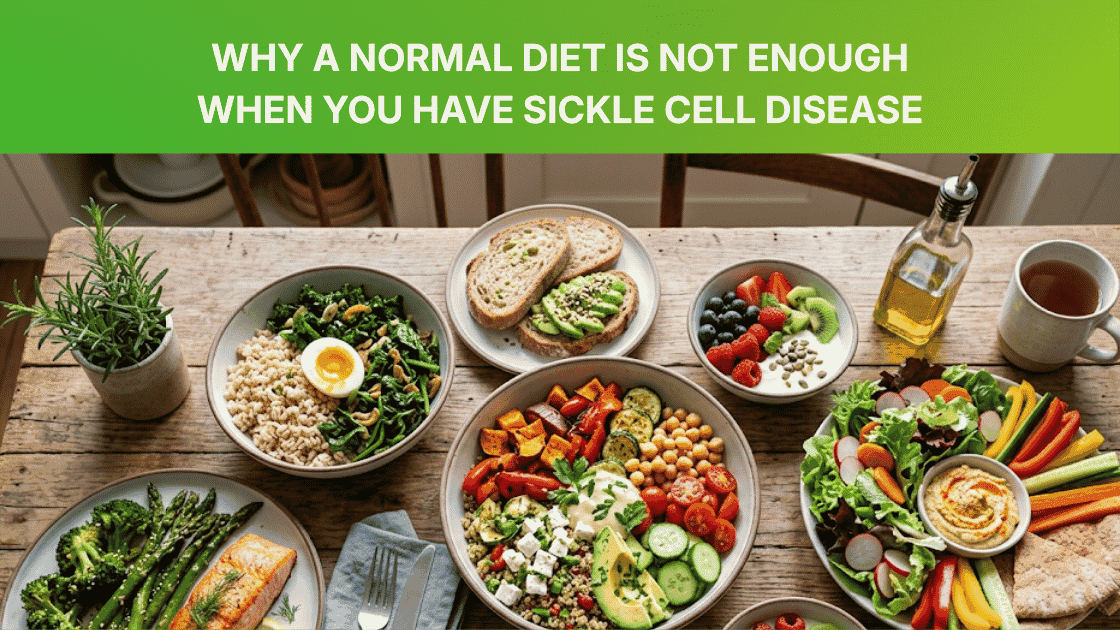
Eating three balanced meals a day sounds like the right thing to do. For most people, it is. But if you live with sickle cell disease, that same routine can leave your body short-changed, not because you're eating badly, but because your body needs significantly more than the average person just to function.
This isn't something that comes up often in routine care. Most nutrition advice was built around healthy people. It wasn't designed to account for what sickle cell puts your body through every single day, even when you're feeling okay.
Key Takeaways
- Research shows the body burns approximately 15% more calories at rest in people with sickle cell disease, compared to those without it (American Journal of Physiology, 1998).
- In children with SCD, resting calorie burn was an average of 131 extra calories per day above matched healthy peers (Journal of Pediatrics, 2004).
- Standard dietary guidelines don't account for these elevated needs, creating a quiet, ongoing shortfall.
- Frequent small meals, adequate protein, and targeted nutrients including zinc are key pillars of good nutrition with SCD.
NATURAL SUPPLEMENTS FOR SICKLE CELL
Why Does Sickle Cell Disease Make Your Body Burn More Energy?
The answer starts with what sickle cell does to your red blood cells. In a healthy body, red blood cells live for about 120 days. In someone with sickle cell disease, those same cells only last 10 to 20 days before they break down and need to be replaced.
Your bone marrow has to work constantly to produce new cells, and that process costs energy.
On top of that, the heart beats faster to move oxygen around a body that doesn't have enough healthy red blood cells. Low-grade inflammation is almost always present in the background, even between crises.
All of this is happening at once, every day, without any outward signs.
Your body is doing the equivalent of a slow, continuous workout just to maintain its baseline.
The calories you burn sitting still are measurably higher than they would be without the disease.
What Does Eating Enough Actually Look Like?
Getting enough calories is the foundation. Everything else builds on top of it. Research consistently shows that nutritional supplements perform poorly in a body that isn't getting enough total food energy to begin with. So before focusing on individual nutrients, the overall food intake needs to be enough.

A practical target for most people with sickle cell disease in a stable period is roughly 120% of the standard daily calorie recommendation for their age and sex.
During a crisis, an infection, or recovery from any illness, the need rises even further. These are not numbers that come from standard nutrition consultations.
They require someone who understands the specific demands of the disease.
Protein also matters more than most people realise. Research shows the body breaks down and rebuilds protein at a significantly higher rate in people with sickle cell disease than in healthy peers.
Consistently eating enough protein, through eggs, legumes, fish, poultry, or plant-based sources, supports muscle health and tissue repair in a way that directly affects how well the body handles the demands of the disease.
Getting the calorie foundation right is the difference between a body that can heal, fight infection, and grow, and one that is quietly diverting resources just to survive.
WHAT TO EAT WITH SICKLE CELL
Why Do Smaller, More Frequent Meals Work Better?
Many people with sickle cell disease find it difficult to finish large meals. This is partly due to the appetite suppression that comes with ongoing inflammation and partly because the digestive system is under extra pressure in a body managing high levels of physiological activity.
Spreading food intake across four to six smaller meals during the day tends to result in better overall calorie consumption than three large meals.
It reduces the effort of digestion at any one time and makes it easier to reach the daily total the body actually needs.
The Nutrients That Matter Most
Beyond total calories, certain nutrients are consistently depleted in people living with sickle cell disease. Zinc is one of the most well-documented. Research has linked zinc deficiency in SCD to poor wound healing, weakened immunity, and disrupted growth in children.
Multiple clinical trials support zinc supplementation as a specific intervention for people with the disease.
Omega-3 fatty acids and B vitamins, especially folate, also play documented roles in supporting red blood cell health and reducing the severity of inflammation.
At Healing Blends Global, Dr. Charlie Ware has developed HB Zinc specifically for people living with sickle cell disease. It's one of several evidence-based supplements in a range designed around the real nutritional demands of the condition. EvenFlo, the brand's flagship supplement, has shown 93% effectiveness in a clinical study.
The Bottom Line
Sickle cell disease places higher demands on the body than standard nutrition advice accounts for.
Eating what's "normal" for a healthy person is often not enough.
The body burns more, rebuilds faster, and depletes key nutrients more quickly. Understanding that, and eating accordingly, is one of the most practical things someone with SCD can do for their long-term health.
For deeper reading on managing sickle cell disease through nutrition and natural support, visit the Healing Blends blog. And to track your health day to day, visit elohehkits.com.
Frequently Asked Questions
Why do people with sickle cell disease need more calories than other people?
Sickle cells break down much faster than normal red blood cells, roughly every 10 to 20 days instead of the usual 120.
The body works hard to replace them continuously, which costs significant energy even at rest.
Does this apply to children with sickle cell too?
Yes. Research involving children aged 5 to 18 with sickle cell disease found they burned an average of 131 more calories per day at rest than matched healthy children.
This contributes to slower growth and delayed development when calorie intake isn't adjusted accordingly.
What foods are especially important for people with sickle cell?
Calorie-dense whole foods; good protein sources (eggs, legumes, fish, and poultry); foods rich in folate; and zinc-containing foods such as pumpkin seeds, beans, and whole grains are all important.
Hydration also plays a key role in reducing the risk of a crisis. For a full guide, visit the Healing Blends nutrition blog.
Can supplements help with the nutritional needs of sickle cell disease?
Targeted supplementation, especially zinc, has solid evidence behind it for people with SCD.
The key is that supplements work best alongside adequate overall calorie intake, not as a replacement for it.
How can I track my nutrition and symptoms together?
The Eloheh app lets you log symptoms, medications, and daily patterns over time.
That kind of consistent tracking makes conversations with your doctor or dietitian far more useful at a single appointment.
This article is for educational purposes only and does not constitute medical advice. Always consult a qualified haematologist or healthcare provider for personal medical decisions.
elohehkits.com | @elohehkits